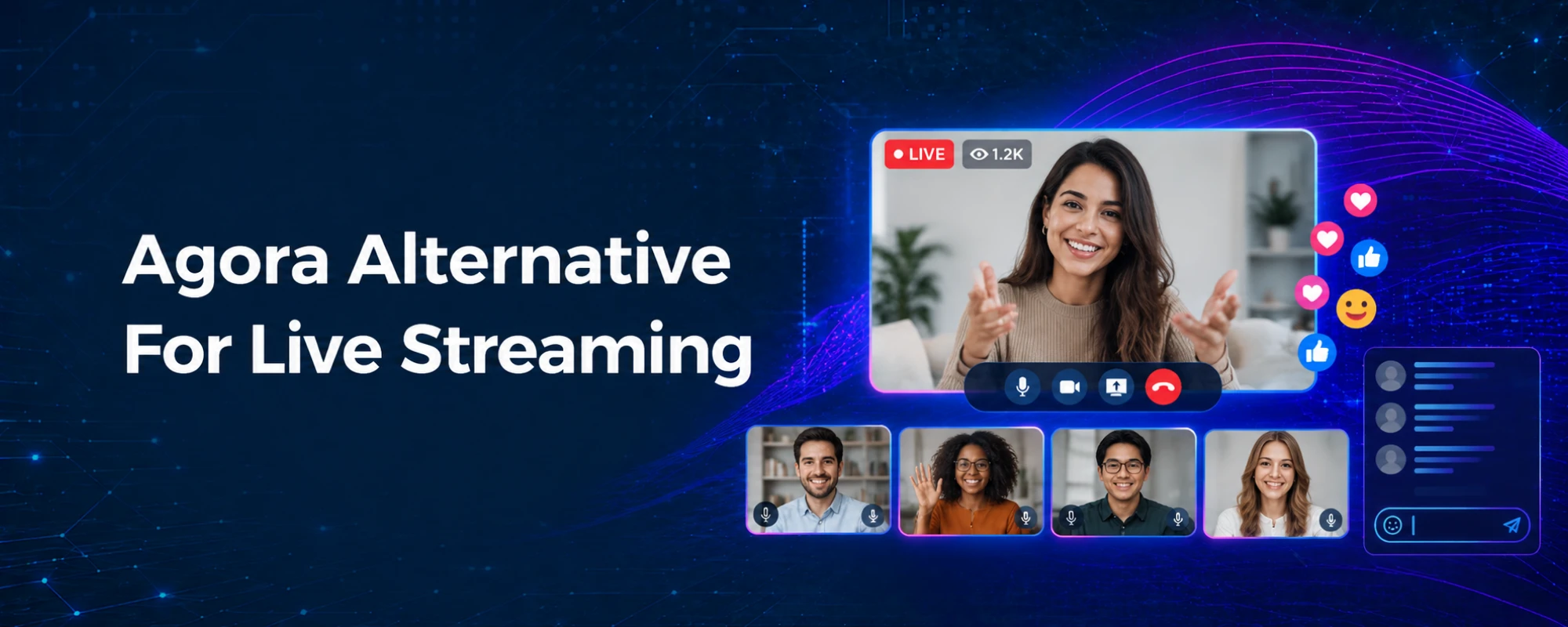
Agora helped thousands of apps add real-time video. As products grow, though, many teams start hunting for an Agora alternative for live streaming. Bills get harder to predict. Audiences outgrow interactive rooms. Roadmaps call for features that Agora doesn’t offer out of the box.
This guide covers what to look for and which platforms deserve a look. It also explains how to switch without disrupting your users. The same core questions apply whether you run a live shopping app in Texas or an edtech platform serving Southeast Asia.
Why Teams Look for an Agora Alternative For Live Streaming
Agora is a mature platform with broad SDK coverage and a large global network. Still, a few friction points come up often in buyer reviews and migration discussions. Most stem from growth rather than outright failure.
Here are the most common triggers:
- Pricing tied to resolution. Agora’s video pricing is tiered by resolution, so HD and Full HD streams cost more per minute.
- Hard-to-forecast bills. One viral stream can push a month’s usage far past budget.
- Interactive vs. broadcast tradeoffs. Rooms built for a few hosts don’t always map cleanly to massive audiences.
- Commerce feature gaps. Product tagging, flash sales, and gifting usually require custom builds.
- Data residency reviews. Regulated US teams often need clear answers on where media is routed and stored.
- Vendor lock-in. Deep use of proprietary SDK features makes moving later costly.
None of this makes Agora a bad choice. It means the right platform depends on your use case, scale, and margins. Review sites like Gartner Peer Insights and G2 show how real customers rate these tradeoffs.
What to Evaluate Before You Switch
Feature checklists can mislead you. Two platforms may both “support live streaming” yet behave very differently under real load. Focus on the criteria that affect your users and your unit economics.
| Criterion | What to Ask | Why It Matters |
| Latency | Is delivery sub-second (WebRTC) or several seconds (HLS)? | Auctions, live selling, and Q&A need near real-time interaction |
| Scale | How many hosts and viewers per session? | Decides whether you can grow from small rooms to big events |
| Pricing model | Per minute, per participant hour, or custom? Does resolution change the rate? | Drives margins as usage climbs |
| SDK coverage | iOS, Android, web, React Native, Flutter? | Gaps mean extra engineering work |
| Ingest and output | RTMP/OBS ingest, recording, restreaming? | Creators expect pro tools and social reach |
| Compliance | SOC 2, HIPAA, GDPR support? | Required for telehealth, finance, and enterprise deals |
| Engagement features | Chat, gifting, product tagging, moderation? | Saves months of custom development |
Beyond the table, watch for these hidden costs:
- Cloud recording and storage fees
- Transcoding charges for adaptive bitrate
- Bandwidth or egress fees on large audiences
- Paid support tiers for guaranteed response times
Run a proof of concept using your real traffic patterns before signing a contract. A two-week test on actual phones and spotty networks beats any spec sheet.
Top Managed Cloud Alternatives to Agora
Managed platforms handle servers, scaling, and global delivery for you. For most startups and mid-market teams, they’re the fastest path to launch. The tradeoff is less control over infrastructure and pricing.
| Platform | Best Fit | Notable Strength | Pricing Style |
| Stream Video | Apps mixing calls, livestreams, and live shopping | Single SDK with per-participant quality scaling | Usage-based |
| 100ms | Developer-led interactive streaming | Prebuilt UI templates | Usage-based |
| Zegocloud | Global consumer apps | Prebuilt UI kits and AI effects | Usage-based |
| Twilio Video | Teams already using Twilio messaging | Ties into SMS, voice, and Flex | Per participant minute |
| Vonage Video API | Flexible session sizes | Rates not tied to video resolution | Usage-based |
| Amazon IVS | Broadcast-scale events on AWS | Real-time stages for large audiences | Hourly, usage-based |
| Isometrik Livestream SDK | Live commerce and social apps | Live selling, PK battles, restreaming built in | Contact for quote |
A few quick takes on the standouts:
- Stream Video adjusts resolution and bitrate for each viewer, which helps on weak mobile connections.
- Zegocloud offers ready-made UI kits that shorten build time for consumer apps.
- Twilio Video almost went away. Twilio planned its retirement, then reversed course in October 2024. It now remains a standalone product.
- Amazon IVS Real-Time Streaming supports up to 12 hosts and 10,000 viewers per stage, with latency under 300 milliseconds. See the AWS announcement for details.
The Isometrik live streaming SDK targets a gap most video APIs leave open: monetization. It includes live selling, shoppable videos with product tagging, and PK battles with virtual gifting. Hosts can go live from web, app, or OBS, then restream to YouTube, Instagram, and Facebook. Webhooks connect stream events, moderation, and recordings to your backend.
Open-Source and Self-Hosted Options
Some teams want full control over infrastructure, data, and long-term costs. Open-source media servers make that possible. They also shift the heavy lifting onto your own engineers.
Two options lead the pack:
- LiveKit: A modern open-source WebRTC SFU written in Go. It has strong client SDKs and a framework for voice and AI agents. The code lives on GitHub, and a managed cloud version is also available.
- mediasoup: A low-level WebRTC library for Node.js. It offers granular control over media routing and CPU use per participant.
Self-hosting can trim per-minute costs at very high volume. But your team then owns uptime, scaling, TURN servers, monitoring, and security patches. For many companies, the savings shrink once you add DevOps salaries and on-call hours.
A simple rule of thumb helps. Choose self-hosting if video is your core product and you have WebRTC talent in-house. If video supports a bigger product, a managed platform usually wins. Our guide on the build vs. buy decision walks through that math in more detail.
Matching the Platform to Your Use Case
The best Agora alternative depends on what actually happens during your streams. A fitness class and a flash sale have very different needs. Here’s how common use cases line up.
| Use Case | Must-Have Features | Best-Fit Platform Type |
| Live shopping | Product tagging, flash sales, checkout links, restreaming | Commerce-ready SDK like Isometrik |
| Online classes | Low-latency Q&A, screen share, recording | Interactive video SDK |
| Telehealth and wellness | HIPAA-ready setup, private rooms, recording controls | Managed provider that signs a BAA |
| Fitness classes | Smooth mobile video, chat, scheduling | Managed SDK with prebuilt UI |
| Social and creator apps | Gifting, PK battles, moderation, virtual currency | Engagement-focused SDK like Isometrik |
| Large events and launches | Huge reach, broadcast quality | Amazon IVS or HLS with a CDN |
Live shopping deserves a closer look. It blends video, chat, and checkout into one moment. A stall at any step costs you sales.
The features that keep that moment moving include:
- Real-time product pins that viewers can tap to buy
- Live chat so hosts can answer sizing and shipping questions
- Restreaming to social channels for wider reach
- Recording so streams keep selling after they end
Pairing video with an in-app chat SDK keeps questions flowing while the host sells. For private consultations after a stream, an audio and video calling SDK moves the shopper into a one-on-one call. Brands in the US and APAC already use this format to turn viewers into buyers.
How to Migrate Off Agora Without Breaking Your App
Switching video providers is very doable with a solid plan. Most teams take a staged approach to limit risk. Here’s the playbook:
- Audit current usage. Pull minutes, peak concurrency, resolution mix, and regions from the last 90 days.
- Map every feature. List what you use, from cloud recording to real-time messaging.
- Build a proof of concept. Recreate your core streaming flow on the new SDK using real devices.
- Load test. Simulate peak traffic and poor networks before real users arrive.
- Run both in parallel. Route a small share of users to the new platform behind a feature flag.
- Cut over in stages. Expand by region or user segment while tracking quality metrics.
- Decommission. Remove Agora code only after a stable stretch.
Plan around app store review times, too. Users on older app versions may still need the Agora path for weeks. Keep both code paths live until adoption of the new version is high.
Finally, set clear success metrics before launch. Track join time, rebuffering rate, crash rate, and cost per streamed hour. These numbers tell you whether the switch actually paid off.
Choosing the Right Agora Alternative For Live Streaming
There’s no single winner, and that’s good news. Teams needing flexible, general-purpose video often land on Stream, Zegocloud, or Vonage. AWS-native broadcast events fit Amazon IVS. Engineering-heavy teams that want control lean toward LiveKit or mediasoup.
If your streams need to sell, reward, or engage, look at a commerce-ready Agora alternative for live streaming like Isometrik. Live selling, gifting, restreaming, and moderation come built in, so your team skips the basics. Book a free strategy call to map the right setup for your app.
Leave a Reply